

Key Takeaways:
- Continuous-duty motors must reach thermal steady state without overheating, requiring NEMA S1 (IEC) or continuous duty rating with proper service factor and insulation class
- Baldor motors (now ABB) deliver NEMA Premium efficiency with 1.15 service factors, Class F insulation with Class B temperature rise, and severe-duty construction for 24/7 operation
- Service factor defines safe overload capacity: motors with 1.15 SF can handle 15% over nameplate rating, but continuous operation above rated HP reduces expected motor life significantly
- Proper enclosure selection (TEFC, ODP, severe duty) protects against environmental contaminants and is the most common cause of premature motor failure when specified incorrectly
- Energy-efficient motors (NEMA Premium IE3) save substantial operating costs in continuous applications where motor runs 4,000+ hours annually and power consumption exceeds purchase price
In continuous-duty industrial applications, electric motor selection determines whether your process runs reliably for years or suffers repeated failures and costly downtime. A motor specified for intermittent duty that runs continuously will overheat, fail prematurely, and leave your production line idle. At AMED-US, we work daily with plant engineers who need motors capable of delivering consistent power 24 hours per day, 365 days per year in demanding industrial environments.
Selecting motors for continuous operation requires understanding duty cycles, service factors, thermal management, enclosure protection, and efficiency standards that directly impact both reliability and operating costs. As an authorized distributor of Baldor motors, WEG, and other leading manufacturers, we help clients across North and Latin America specify motors that handle continuous loads in processing plants, water treatment facilities, mining operations, and manufacturing environments where downtime carries severe consequences.
Understanding Continuous-Duty Requirements
Continuous duty represents the most demanding motor application category. When we refer to continuous-duty operation, we are describing motors that run long enough to reach thermal steady state, where internal temperatures stabilize at their maximum design levels. This differs fundamentally from intermittent duty motors that operate in short bursts with cooling periods between runs.
According to IEC 60034-1 standards, continuous duty is classified as S1, meaning the motor operates at constant load for sufficient time to reach thermal equilibrium. NEMA similarly defines continuous duty motors as those designed to operate at rated load without time limit. The motor must be able to handle its rated horsepower continuously without exceeding safe operating temperatures defined by its insulation class.
The thermal challenge in continuous operation cannot be overstated. Motors convert electrical energy to mechanical power with typical efficiencies of 90-96%, meaning 4-10% of input power becomes heat that must be dissipated. In a 100 HP motor operating continuously, this represents 10,000-25,000 BTU/hour of heat generation that must be removed through the motor housing and cooling system. Failure to adequately dissipate this heat leads to insulation breakdown, bearing failure, and catastrophic motor damage.
Applications requiring continuous-duty motors include pump drives in water and wastewater treatment, fans and blowers in HVAC and process ventilation, conveyor systems moving materials around the clock, compressors for industrial air systems, mixers and agitators in chemical processing, and extruders in plastics manufacturing. Our work with these industries at AMED-US confirms that proper motor specification prevents the majority of premature failures we encounter.
Baldor Severe Duty Motor Advantages
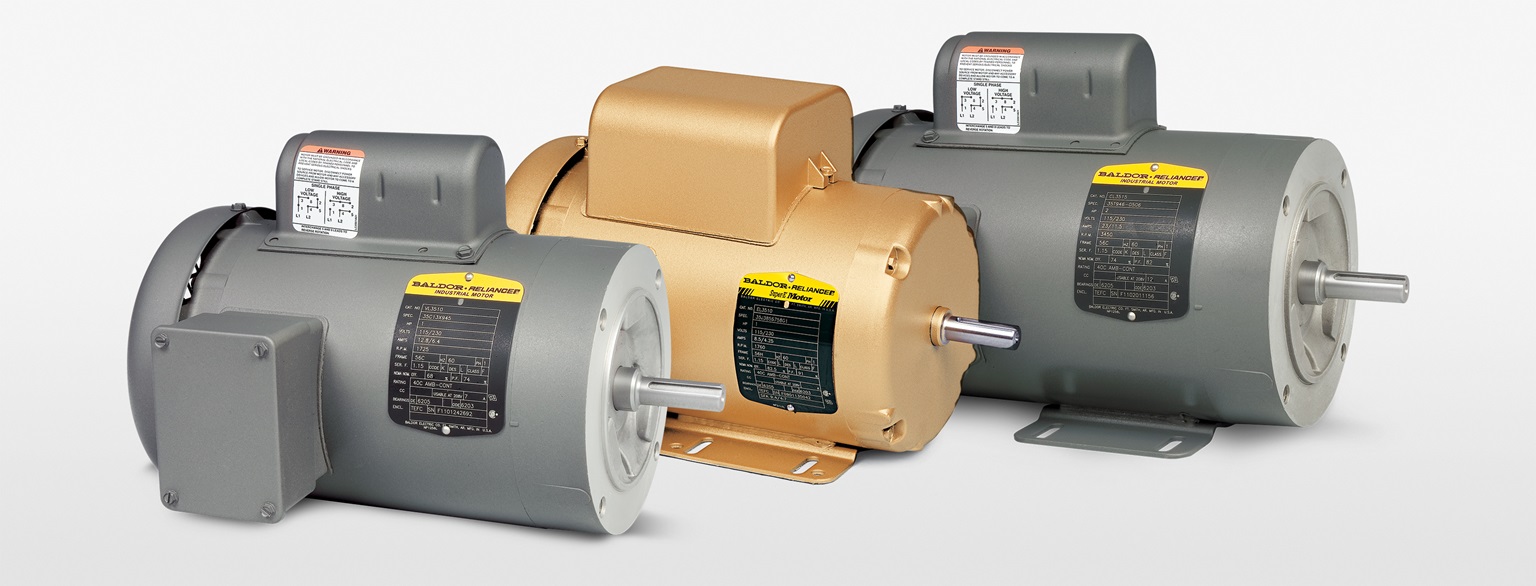
Baldor-Reliance motors, now part of ABB, represent the industry standard for continuous-duty industrial applications. With over 150 years of combined engineering excellence between Baldor and ABB, these motors deliver exceptional reliability specifically designed for harsh environments and demanding duty cycles.
The Baldor Severe Duty motor line incorporates premium construction features that address the specific challenges of continuous operation. Heavy-duty cast iron enclosures provide superior structural integrity and heat dissipation compared to steel fabrications. The thermal mass of cast iron housings helps regulate operating temperatures during sustained loads.
Baldor’s patented bearing lubrication systems ensure consistent lubrication delivery throughout extended operating periods. The PLS (Positive Lubrication System) found in IEEE 841XL motors provides continuous bearing protection that eliminates the premature bearing failures common in motors operating 8,000+ hours annually.
Advanced sealing systems protect against contamination that accelerates wear in continuous-duty applications. V-ring shaft slingers, labyrinth seals, and specialized breather drains prevent ingress of moisture and particulates while allowing internal pressure equalization. These features prove critical in applications where motors operate in dusty, humid, or chemically aggressive environments.
Electrical design in Baldor severe duty motors includes Class F insulation with Class B temperature rise ratings. This provides substantial thermal margin, allowing the motor to operate well below its insulation temperature limits even under full continuous load. The resulting extended insulation life translates directly to longer motor service life in demanding applications.
Service factors on Baldor motors typically reach 1.15 for continuous-duty ratings, providing 15% overload capacity for handling transient loads without compromising continuous operation capability. This reserve capacity proves valuable in applications where process conditions create occasional peak demands above steady-state requirements.
NEMA Standards and Service Factor Considerations
Understanding NEMA standards is essential for proper motor selection in continuous-duty applications. The National Electrical Manufacturers Association establishes comprehensive specifications that define motor performance, construction, and rating methods.
Service factor represents one of the most critical NEMA specifications for continuous operation. NEMA MG 1 defines service factor as “a multiplier, which, when applied to the rated horsepower, indicates a permissible horsepower loading which may be carried under the conditions specified for the service factor.” A motor with a 1.0 service factor cannot be expected to handle more than its nameplate horsepower on a continuous basis. A motor with a 1.15 service factor can handle infrequent loads up to 15% past rated horsepower.
However, NEMA MG1 9.15.1 provides critical guidance: “An induction motor operated at any service factor greater than 1.0 will have a reduced life expectancy compared to operating at its rated nameplate horsepower.” This means that while a 1.15 service factor motor can handle 115% load, continuous operation at this elevated level shortens motor life through increased heating and stress on insulation and bearings.
For true continuous-duty applications at AMED-US, we recommend sizing motors to operate at or below their nameplate rating during steady-state conditions. The service factor then provides margin for transient overloads, starting conditions, or temporary process variations rather than serving as normal operating capacity.
NEMA efficiency standards directly impact operating costs in continuous applications. NEMA Premium efficiency motors meet stringent efficiency requirements that reduce energy consumption. In a 100 HP motor operating 8,000 hours annually, improving efficiency from 94% to 96% saves approximately $3,500 per year at $0.10/kWh electricity costs. Over a 20-year motor life, this efficiency improvement saves $70,000 while reducing environmental impact.
Temperature rise ratings define how much a motor’s winding temperature can increase above ambient during operation. NEMA specifies maximum temperature rises for different insulation classes. Class B insulation allows 80°C rise by resistance, Class F allows 105°C rise, and Class H allows 125°C rise, all based on 40°C ambient temperature. Using higher insulation classes with lower temperature rise (such as Class F insulation with Class B rise) provides thermal margin that extends insulation life in continuous service.
Enclosure Selection for Operating Environment
Motor enclosure type directly affects reliability and service life in continuous-duty applications. The enclosure protects internal components from environmental contaminants while managing heat dissipation. Selecting the wrong enclosure type is the most common cause of premature motor failure according to industry analysis.
Open Drip-Proof (ODP) enclosures provide excellent cooling through unrestricted air circulation but offer minimal protection against environmental contaminants. These motors work well in clean, indoor environments where dust, moisture, and chemical exposure are minimal. The open design maximizes cooling efficiency, making ODP motors suitable for continuous operation in appropriate environments. However, we rarely recommend ODP enclosures for industrial applications where contamination risk exists.
Totally Enclosed Fan Cooled (TEFC) enclosures represent the most common choice for continuous-duty industrial motors. The sealed housing prevents ingress of dust, moisture, and debris while an external fan provides forced air cooling across the motor surface. TEFC motors protect against harsh environments while maintaining adequate cooling for continuous operation. Most manufacturers now offer TEFC motors with 1.15 service factors matching ODP motor capabilities.
Severe duty TEFC motors from Baldor incorporate enhanced protection features for the most demanding continuous applications. Specially formulated epoxy paint systems resist corrosion, chemical attack, and UV degradation. Stainless steel breathers and drains prevent condensation accumulation during temperature cycling. Oversized conduit boxes facilitate safe wiring installation and maintenance access. These features prove essential in applications like wastewater treatment, chemical processing, and coastal environments.
Explosion-proof enclosures meet stringent requirements for hazardous locations where flammable gases, vapors, or combustible dust may be present. These motors are certified for specific hazardous location classifications (Class I Division 2, Class II, etc.) and incorporate construction features that prevent ignition of surrounding atmosphere. Continuous-duty operation in hazardous locations demands motors specifically rated for both the environmental classification and continuous thermal loading.
Washdown duty motors feature stainless steel or special coatings that withstand frequent cleaning with high-pressure water and sanitizing chemicals. Food processing, pharmaceutical manufacturing, and other hygiene-critical applications require these specialized enclosures for motors in continuous operation. The enhanced corrosion protection ensures long service life despite aggressive cleaning protocols.
IP (Ingress Protection) ratings provide standardized enclosure protection levels recognized internationally. IP55 and IP56 ratings typical of industrial severe duty motors indicate protection against dust ingress and water jets from multiple directions. Higher IP ratings may be required for motors exposed to submersion, extreme wash-down, or other severe environmental conditions.
Motor Efficiency and Energy Considerations
Energy efficiency becomes critically important in continuous-duty applications where motors operate thousands of hours annually. The relationship between motor efficiency and operating cost means that energy consumption over a motor’s life can exceed initial purchase price by 10-50 times.
NEMA Premium efficiency motors (equivalent to IE3 international classification) represent the minimum efficiency standard for most continuous industrial applications. These motors incorporate design improvements including optimized magnetic circuits, reduced air gaps, improved cooling, and higher-grade materials that reduce losses. The efficiency improvements translate directly to reduced electricity consumption and lower operating temperatures.
Consider a 50 HP motor operating continuously in a water treatment facility. At 95% efficiency versus 92% efficiency, the difference represents approximately 1.6 kW additional power consumption. Over 8,760 hours annual operation at $0.10/kWh, this efficiency difference costs $1,400 per year. The NEMA Premium motor typically pays for its modest price premium within 1-2 years through energy savings.
Beyond direct energy costs, higher efficiency motors run cooler, reducing stress on insulation, bearings, and other components. This thermal benefit extends motor life and reduces maintenance requirements in continuous service. The reduced heat generation also decreases cooling load in enclosed spaces, providing additional energy savings in climate-controlled facilities.
Variable Frequency Drive (VFD) compatibility represents another crucial efficiency consideration for continuous motors where speed control provides process benefits. Inverter-duty motors rated for VFD operation incorporate specialized insulation systems that withstand voltage spikes and high-frequency harmonics generated by drive electronics. When process requirements allow variable speed operation, VFD-controlled motors can deliver 20-50% energy savings compared to fixed-speed operation with mechanical throttling.
Power factor affects electrical system efficiency and utility costs. Motors with higher power factors reduce reactive current draw, minimizing transmission losses and potentially avoiding utility demand charges. In facilities with multiple continuous-duty motors, power factor correction through motor selection or capacitor banks improves overall electrical system efficiency.
Proper Motor Sizing and Application Factors
Correct motor sizing ensures reliable continuous operation without premature failure. Undersized motors run continuously above their thermal design limits, causing rapid insulation degradation and bearing wear. Oversized motors operate inefficiently at light loads with reduced power factor, though this is preferable to undersizing for continuous applications.
Load calculation begins with accurately determining the mechanical power required by the driven equipment. This includes not just steady-state running load but also starting torque, acceleration requirements, and any transient overloads the system experiences during normal operation. We work with clients at AMED-US to analyze actual load profiles rather than relying on nameplate data that may not reflect real operating conditions.
Ambient temperature significantly affects motor capacity in continuous operation. NEMA standards assume 40°C (104°F) ambient temperature. Operation in higher ambient temperatures reduces the motor’s ability to dissipate heat, effectively reducing available continuous capacity. For every 10°C increase in ambient temperature above rated conditions, motor capacity must be derated or insulation life is reduced by approximately 50%.
Altitude affects motor cooling and electrical characteristics. At elevations above 3,300 feet (1,000 meters), reduced air density decreases cooling effectiveness. Motors rated with 1.15 service factor typically must be derated to 1.0 service factor when operated above this altitude, or higher ambient temperature derating must be applied. For continuous-duty applications at high altitude, we recommend specifying motors rated for the actual installation altitude.
Mounting position affects heat dissipation and bearing loading. Motors designed for horizontal mounting may have reduced capacity or require modification for vertical mounting. Continuous-duty vertical motors require specialized bearing arrangements to handle axial thrust loads and may need separate cooling provisions to ensure adequate heat removal in the vertical orientation.
Duty cycle analysis determines whether true continuous duty is required or whether intermittent duty ratings suffice. Some applications that appear continuous actually have regular idle periods sufficient for cooling. Accurately characterizing the duty cycle can allow more economical motor selection while maintaining reliability.
Critical Selection Criteria Checklist
When specifying motors for continuous-duty industrial applications, we guide clients through systematic evaluation of these critical factors:
Power Requirements: Calculate actual mechanical load including starting torque, running load, and peak transient loads. Include safety margin but avoid excessive oversizing that reduces operating efficiency.
Operating Environment: Assess ambient temperature, altitude, humidity, presence of dust or moisture, chemical exposure, and any hazardous area classifications. These factors determine required enclosure type and special construction features.
Duty Cycle: Confirm true continuous operation requirements. Document actual running hours per day, starts per hour, load variations, and any rest periods that allow cooling.
Service Factor: Specify appropriate service factor based on application requirements. Use 1.15 SF for standard industrial continuous duty, 1.0 SF for motors operating at service factor load continuously.
Efficiency Class: Select NEMA Premium (IE3) minimum for continuous applications to minimize operating costs and reduce heat generation.
Insulation Class: Specify Class F insulation with Class B temperature rise for superior thermal margin in continuous service.
Speed Control: Determine if VFD operation provides process or energy benefits. Specify inverter-duty motors if VFD control will be used.
Starting Method: Evaluate starting requirements and select appropriate motor design (NEMA Design B standard, Design C for high starting torque). Ensure starting method is compatible with electrical system capacity.
Mounting Configuration: Specify foot-mounted, flange-mounted, or shaft-mounted as required by the driven equipment and installation constraints.
Special Features: Identify requirements for space heaters (moisture prevention during shutdown), bearing RTDs (temperature monitoring), insulated bearings (VFD applications), special shaft seals, or other application-specific features.
Working with AMED-US for Motor Selection
Proper motor selection for continuous-duty applications requires expertise that extends beyond catalog comparisons. At AMED-US, our engineering team provides comprehensive support throughout the selection, procurement, and commissioning process.
We begin every motor project with detailed application analysis. Understanding your specific operating conditions, load profiles, environmental factors, and reliability requirements allows us to recommend solutions optimized for your actual needs rather than generic specifications. This consultation prevents costly errors we regularly see when motors are selected without expert guidance.
As an authorized distributor for Baldor, WEG, US Motors, and other leading manufacturers, we provide access to the complete range of continuous-duty motors with competitive pricing and reliable delivery throughout the Americas. Our inventory includes common frame sizes for rapid shipment, while our supply chain relationships enable expedited delivery of specialized units when projects demand quick turnaround.
Beyond equipment supply, we offer complete system support. Our team assists with installation planning, ensuring proper mounting, alignment, and electrical connections. We provide commissioning support to verify motor operation meets design specifications before your facility assumes production responsibility. Our motor services include preventive maintenance programs, condition monitoring, and repair/rewind capabilities that extend motor life in continuous-duty applications.
Our technical support continues throughout your motor’s service life. We help troubleshoot operational issues, interpret monitoring data, and plan proactive replacements before failures cause unplanned downtime. This ongoing partnership ensures your continuous-duty motors deliver the reliability your operations demand.
With teams in Miami, Medellin, Santiago, and Guayaquil, we provide local support across North and Latin America. This geographic coverage ensures you have access to technical expertise, replacement parts, and emergency service wherever your facilities operate.
Ensuring Long-Term Reliability
The investment in properly specified continuous-duty motors pays dividends through years of reliable operation and minimized downtime. While initial costs may exceed that of general-purpose motors, the total cost of ownership strongly favors motors designed specifically for continuous service.
Consider the broader system requirements beyond the motor itself. Ensure adequate electrical supply capacity for starting current. Provide proper ventilation around the motor to prevent localized high temperatures. Implement vibration isolation if the driven equipment or installation creates excessive vibration. Install protective devices appropriate for the application including thermal overload protection sized correctly for the motor’s actual operating current.
Establish preventive maintenance schedules appropriate for continuous operation. Regular inspection of bearing condition, winding temperature, vibration levels, and electrical characteristics allows early detection of developing problems before they cause failures. For critical continuous processes, consider condition monitoring systems that provide real-time motor health data.
Documentation of motor specifications, installation details, and operating history proves invaluable for troubleshooting and future replacement. Maintain records of actual operating hours, load conditions, and any modifications or repairs performed throughout the motor’s life.
Get Expert Motor Selection Guidance
Selecting electric motors for continuous-duty industrial applications requires balancing technical performance, environmental protection, energy efficiency, and total cost of ownership. The consequences of improper selection include premature failures, excessive energy costs, and production disruptions that far exceed any initial savings from underspecified equipment.
Contact AMED-US today to discuss your continuous-duty motor requirements with our engineering team. We will evaluate your specific application, recommend appropriate Baldor or other manufacturer motors sized for reliable long-term performance, and provide ongoing support to ensure your motors deliver the continuous operation your processes demand. Your production uptime is our commitment.